Unleashing the Transformative Power of 5G Network Benefits
The emergence of new wireless technology has paved the way for faster, more innovative, and more secure digital ecosystems. The benefits of the 5G network stand out among the next-generation technologies as particularly significant for businesses, people, and society. Whereas previous wireless technologies provided faster Internet, 5G has the power to radically change several elements of mobility, innovation, and security.
From potential 5G benefits for business to how 5G compares to 4G Internet speed, businesses and customers have just begun to understand the scope of what these technologies can offer. Furthermore, with 5G coverage in the USA expanding and making changes to the workplace of the future, including 5G remote work benefits, it is evident how wireless technology is redefining the future of digital technology while simultaneously paving the way for critical discourse regarding issues such as 5G security.
Understanding the Core 5G Network Benefits
5G wireless technology is not simply 4G that will transfer data faster; it represents a new paradigm of wireless connectivity. Here is a summary of the deliverables:
1. Increased Transfer Speeds
- Data transfers will achieve much faster rates than 4G.
- Minimal delays will create seamless use of virtual cloud gaming and video conferencing.
2. Low Latency
- Latency has significantly reduced the wait time for the connected devices to respond.
- Essential in critical remote surgical procedures, self-driving cars, and industrial automation.
3. Expanded Device Capacity
- An enormous increase in capacity that can handle millions of devices per square km.
- Ideal for smart cities, connected devices, organizations, and the Internet of Things (IoT).
4. Greater Reliability
- 5G technology will ensure reliable connectivity in a dense environment.
- Assures mission-critical communications for organizations, businesses, and government agencies.
5. Improved Energy Usage
- One of the primary designs of 5G was to increase device battery life, thereby needing to be recharged less frequently.
- Greatly improved power consumption in devices and networks.
Advantages of 5G for Business
5G adoption is one of the biggest beneficiaries across industries. The natural business advantages of 5G include efficiency, innovation, and scalability.
Improving Productivity
- Being productive in real-time all over the device and the platform.
- Efficiency is improving the lag time in the cloud-powered business apps.
Enabling Digital Transformation
- Robotics and AI-led operations are on the rise.
- The integration of IoT is stronger in manufacturing, logistics, and healthcare.
Enhancing Customer Experience
- Businesses can generate immersive experiences in shopping (AR) and other avenues.
- The speed of data improves service delivery in banking and retail.
Enabling Remote Work
- Companies with distributed workforces can rely on stable connections.
- Hybrid remote work is supported more efficiently.
The advantages of 5G for business adoption are speed and a more innovative way to enable a sustainable growth model through connectivity.
5G vs 4G Speed Comparison
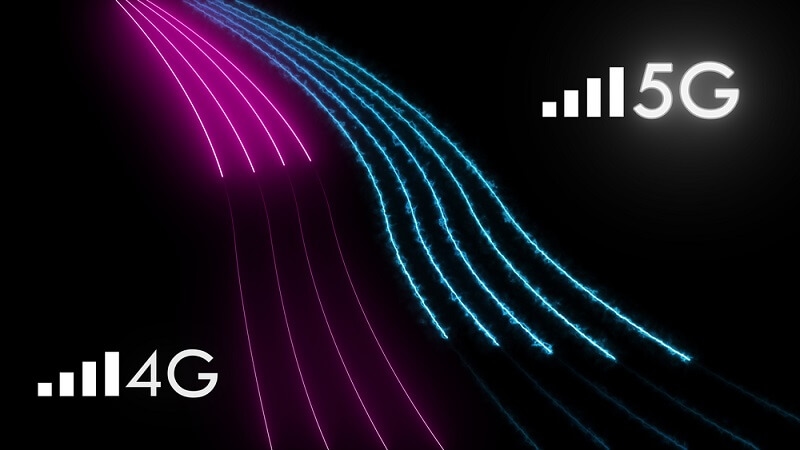
The difference between 5G and 4G is a significant step up when discussing speed.
Speed Advantages:
- 4G Networks: Average speeds are fine for most streaming/browsing experiences.
- 5G Networks: Multi-gigabit speeds, with almost no lag and no loss of quality.
Effect on Applications:
- Streaming: 4G can stream HD, while 5G can easily stream up to 4K and into 8K.
- Gaming: Online gaming and experiences with 5G have almost no lag.
- Data transfer: Large files transfer in just a couple of seconds with 5 GB, as opposed to the minutes it would take with 4 GB.
Why It Matters to Business:
- Remote teams exchanging heavy data files do not have to deal with lag time.
- Enterprise-wide, companies are adopting cloud applications more quickly and integrating more data, undoubtedly with 5G.
The difference in speed means that 5G is not just a technological advancement but is necessary for industries that rely on data-rich operations.
How 5G Improves Remote Work
Models for remote and hybrid work may need stable advanced connectivity. Among the most significant benefits of 5G networks is how 5G enables remote work by solving the restrictions of many previous generations of networks.
Reliable Video Conferencing
- 5G supports uninterrupted HD and 4K conferencing.
- Allows for better collaboration with colleagues across continents in real time.
Improved Cloud Access
- 5G allows remote employees to access applications and storage without delays.
- Data-intensive projects, such as graphics design or analytics, are usable without performance loss.
Secure & Flexible Work
- With 5G, employees can work from virtually anywhere where there is coverage.
- Employees can reduce their vulnerabilities to sensitive business data with encrypted connections.
5G creates an enterprise environment where employees can work in a remote work model that is both possible and highly efficient and secure.
5G Coverage in the USA
The growth of 5G coverage in the USA is crucial for adoption. The availability of networks directly correlates to how much and how quickly enterprises and consumers can leverage these benefits.
Urban Growth
- Large cities and metropolitan areas are where this adoption is happening most rapidly.
- It supports mobility solutions, smart city studies and deployments, and business development.
Rural Coverage
- Expanded coverage to rural communities further supports innovations in agriculture.
- It helps close the digital divide by providing high-speed networks to underdeveloped areas.
Enterprise Opportunities
- Wider coverage provides businesses a platform for deploying similar connectivity across enterprises.
- Retail, logistics, and healthcare industries can create significant impacts.
The growth of 5G coverage is allowing urban and rural communities in the USA to take advantage of comparable digital opportunities.
5G Security Concerns
While there is considerable advantage to be gained from 5G, we also need to address the security issues. As networks expand, we must manage vulnerabilities.
Key Risks
- There is a larger attack surface from billions of IoT devices connected to the 5G networks.
- Network slicing adds layers of complexity that further complicate management.
- Cybercriminals continue to pose an ever-increasing threat to sensitive enterprise data.
Security Solutions
- End-to-end encryption and firewalls, including next-gen firewalls.
- Zero-trust architectures that continuously validate the security of each connection.
- Continuous monitoring and analytics to find unusual traffic patterns.
Enterprise Readiness
- Enterprises must embrace cybersecurity as a strategy before they adopt 5G.
- Allocating both budget and time for training on AI-driven security.
If security is addressed and managed, enterprises will benefit from the increased utilization of 5G without the risk of jeopardizing it.
5G and Industry Innovation
The rollout of 5G fuels innovation across multiple industries, driving unprecedented transformation.
Manufacturing
- Automation powered by AI and IoT devices.
- Real-time monitoring of equipment to reduce downtime.
Healthcare
- Remote surgery and telemedicine become more reliable.
- Instant data sharing among hospitals and clinics.
Retail
- Immersive AR and VR shopping experiences.
- Smart supply chains for real-time inventory tracking.
Transportation
- Autonomous vehicles supported by low-latency connections.
- Logistics improved through fleet tracking and predictive maintenance.
The 5G revolution extends beyond faster internet—it redefines entire industries.
Comparing Global Adoption Trends
As the USA continues to build coverage, global adoption trends illustrate different integration approaches that 5G is taking across regions.
- Asia: Emphasis on smart cities and factory automation.
- Europe: Strong push on enterprise applications and governmental applications.
- North America: Focus on consumer adoption and enterprise solutions.
Diversity of applications highlights the universal opportunity that 5G provides to enable digital economies.
Overcoming Challenges in 5G Deployment
Even with the promise of 5G, obstacles still exist to support wide-scale implementation.
- Costs of Infrastructure: Creating towers from scratch and replacing existing hardware are expensive.
- Accessibility of Spectrum: Restricted access to spectrum to some degree in certain areas leads to delays in expansion.
- Compatibility with Devices: Not all devices have 5G capabilities.
- Awareness of the Public: Misconceptions about 5G cause hesitation in adoption.
By addressing these challenges, both the private sector and public organizations can accelerate adoption and potentially create a more equitable chance of benefit.
Conclusion
The impact of the 5G network benefits is endless. They touch businesses, individuals, and industries with faster speeds, better reliability, and improved security. We can see the impact of 5G on business and witness the ever-growing scope of 5G coverage in America. The reality is apparent: 5G networks provide great transformational potential. Despite observed security concerns, companies using 5G networks will receive enormous competitive advantages over other businesses.
This content was created by AI