

As of 2025, the connections between digital systems and online networks have deepened exponentially. The use of cloud platforms, remote teams, and online transactions is the basis of businesses' smooth running. This has the double effect of creating great convenience on the one hand and cyber risks on the other. To safeguard themselves, companies should grasp the cybersecurity trends 2025 that are characterizing this year.
In 2025, cybersecurity will no longer be viewed solely as a technical issue. Cybercrime is, in fact, becoming a business survival need: AI-powered hacking, more intelligent phishing, and quickly spreading cloud systems are some of the reasons. Almost all cybersecurity trends for 2025 point out that security is to be standard practice in the world.
According to the latest cyber threats in 2025, small and medium businesses (SMBs) will be in the firing line to a great extent. A lot of people think that the perpetrators of cybercrime will only go for the biggest fish in the corporate pond. The truth is that small businesses are often the most poorly protected ones and hence are the easiest targets. This is why it is so important to be up-to-date with the latest cyber threats in 2025.
The latest cyber threats of 2025 reveal that attacks on cloud targets will be even more significant than before. The cloud is the most common place for companies to keep their data. Therefore, a breach in the cloud can be a leakage of a large quantity of data. Besides that, another way that criminals use this year is the supply chain attacks, where they break into a smaller partner company so that they can reach a large corporation quickly.
According to the above-mentioned facts, the conditions for businesses to survive are awareness and early detection. Employees can be trained to know the signs of getting a fake email, setting up alerts for any changes in the system, and getting a monitoring tool investment can help stop the threat before it spreads.
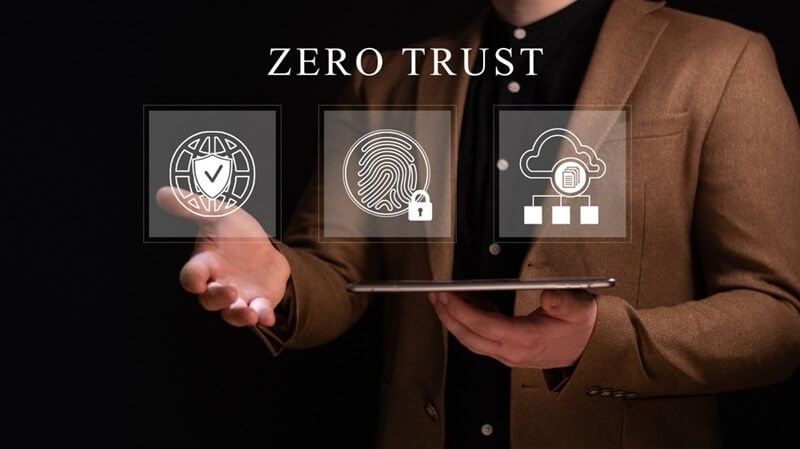
Zero trust security is no longer just a model for choice-it has become a principal or default model for most businesses in 2025. Rather than granting access to anyone within the network, this model constantly calls for re-authentication. Every employee, partner, and even system should prove their identity every time they reach for delicate data.
This method is highly effective in stopping those kind of attacks that steal passwords or find a way in through a weak account. The zero trust security model mitigates the harm by making sure that no single sign-in provides full access to everything. Large data leaks will be much less likely in businesses that employ this model.
Small businesses, if so, complex, many modern tools will make the set-up easy anyway. Multi-factor authentication, role-based access, continuous monitoring are parts of the daily practical implementation of true zero trust albeit not at the heavy cost.
Not paying attention to security is a problem of the past for Small and Medium businesses.. The good news is that there are a lot of cheap and easy-to-use solutions available nowadays. The cybersecurity tools for SMBs in 2025 include:
By using these cybersecurity tools, SMBs are no longer required to hire a large IT team to fortify their defense. In most cases, these tools are subscription services, which makes it easier to scale with the expansion of the business.
Smart technologies do not impede ransomware from keeping its position as one of the top threats in 2025. The hackers get hold of the data of a company and require money so the company can regain access to the data. Thus, the company may not only experience downtime but also financial losses and damage to its reputation.
Businesses are able to minimize the chances of ransomware by implementing the following prevention measures:
These ransomware prevention tips not only lower the risk of ransomware attacks, but also guarantee that if a system is compromised, the criminals will not be paid for the release of the hold.
Just one leak of private information can shatter the trust of customers and result in enormous fines. This is the reason why preventing data breaches has become a topmost priority in 2025. Companies are expected to take even more care with customer information than they have before.
Some easy preventive measures to consider for data breaches would be encrypting sensitive files, securing the cloud platform with a strong password, and conducting security audits on a regular basis. Training employees is also the key, as in most cases, breaches occur due to human mistakes.
With the governments implementing tougher rules on data protection, it follows that there will be legal consequences for breaking the rules apart from the financial loss.
While technology may improve, human errors still remain as one of the main causes of cyber incidents. A hacker can get inside your system very easily if you use phishing emails, weak passwords, and do not take good care of your gadgets. Hence, one of the strongest cybersecurity trends 2025 is the emphasis on cultivating a conscious culture.
Companies are now, More than ever, allocating more capital into Employee training, simulated Phishing tests, and setting up clear policies about the handling of confidential information. With the diligence of cybersecurity as part of their daily routine, companies can reduce the risk associated with human behavior.
The AI used by the criminals is the same one that assists firms in protecting themselves. Automation is now a powerful instrument in cybersecurity. Without even waiting for the clearance from the human, operations can identify and flag all unusual activities, prevent the access of any suspicious login, and even halt the attacks in real time.
In this case, small and medium-sized businesses can utilize the same AI-driven cybersecurity solutions targeting SMBs as large corporations, but at a relatively lower cost, to provide them with comparable security and to make it easier for them to remain seen when facing the changing nature of risks.
The year is 2025, and Cybersecurity is both a challenge and an opportunity. On the one hand, the types of threats are increasingly clever and aggressive. However, businesses now have more tools and processes that can make them tougher than ever before.
Cybersecurity can no longer simply be thought of as a back-office burden; it needs to be integral to how you run a safe and successful business operation. The businesses that understand this will remain secure, sustain customer trust, and continue to thrive in the digital age.
This content was created by AI