

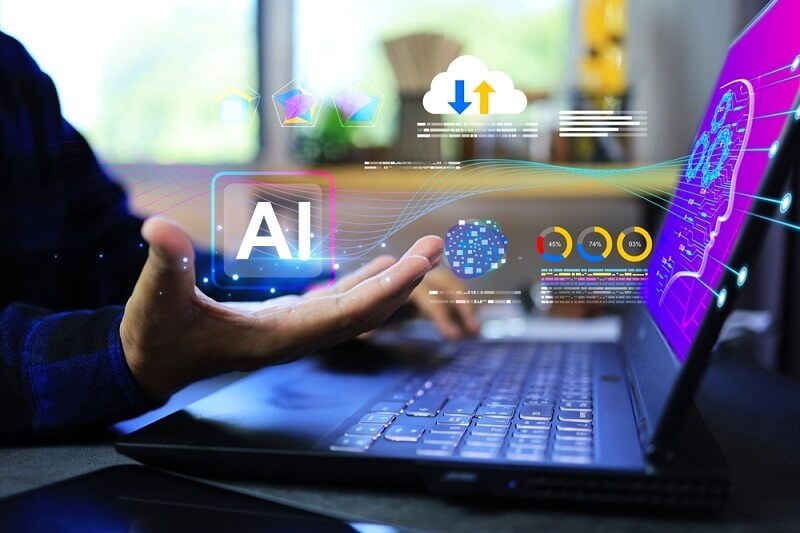
Artificial intelligence in business is no longer the material of science fiction; it's a new material changing industry, big and small. From AI automation software that takes the busy work out of work to AI Customer Service Chatbots that give immediate satisfaction, organizations utilize AI to obtain speed, accuracy, and efficiency. The promise is the same, whether it be enterprise AI or small business AI; improved practices and actionable AI business insights to help unleash your growth package.
This blog article will explore AI for businesses, how businesses are utilizing AI these days, AI business case studies, and why adopting it can be the difference between becoming the market leader or just staying neutral.
The role of AI in business has moved from testing to playing a crucial role in business strategy. Companies are using AI to:
The competitive advantage is clear: With AI, businesses can do more with less, work smarter, and make data-driven decisions in real time.
Businesses across sectors use AI to various degrees, and the list of possible AI use cases in business continues to grow. Below are some of the most significant areas of AI impact:
AI chatbots offer 24/7 support, quickly assist with customer problems, and minimize human agent dependency. Moreover, they can handle FAQs, solve simple problems, and provide grooming services for additional sales, making customers more satisfied and lessening operational expenses.
AI automation tools lessen time spent on repetitive tasks, whether in supply chain scheduling or payroll. AI, for example, in invoice processing can save the user hours of drudgery, and predictive maintenance in manufacturing can lessen downtime.
AI can help a business process customer activity while being involved in ads, emails, or product suggestions. Companies that use AI in marketing get more engagement and conversion.
Numbers are worthless without understanding that software converts the raw numbers into forward-looking models and reports so executives can make strategic decisions faster. Such AI business insights are vital to expansion and risk management.
Not only do big companies enjoy the benefits of AI, but Artificial Intelligence for small businesses is becoming easier to use and less expensive. Affordable tools like automated accounting, CRM systems, and AI-based eCommerce personalization are examples of this.
The most significant benefit of adopting AI automation tools is efficiency.
This switch allows employees to spend time on creative and strategic work while AI handles repetition and adheres to policies.

Customer experience too often determines whether a company gains or loses business. AI customer service chatbots enable companies to provide quicker, more consistent service.
With the implementation of Natural Language Processing (NLP), chatbots are evolving into intelligent systems that provide human-like responses that improve over time.
In this digital age, decisions must be made in seconds, and all decisions must be data-informed. AI business insights give leaders predictive and prescriptive analytics.
AI Business insights make data an asset strategically across small, medium, and large businesses.
The myth that AI is only available to tech giants is now a myth. AI for small businesses provides cost-effective, easy-to-use tools to make growth easier.
Using AI, small companies can compete with larger companies without sacrificing profitability.
Let's look at some examples of AI in business in a variety of industries:
Hospitality uses AI via chatbots that assist customers in booking, answer queries, and provide personalized ideas for travel.
Every industry uses AI automation software to attack unique solutions to industry-specific problems, delivering operational efficiencies.
While the benefits of using AI to enhance business processes and profit margins far outweigh the disadvantages of use, the following challenges need to be considered for organizations:
Notwithstanding these challenges, the benefits outweigh the risks, and AI is a crucial business driver.
Companies that move now will have a considerable lead in the future.
If organizations progress through these steps, they will yield the most incredible value from AI while mitigating any risk.
Artificial Intelligence has become a necessity. From business applications such as chatbots or automation tools to business analysis, employing AI deliberately is important. Whether enterprise organizations or AI for small businesses, AI is helping facilitate smarter, faster, and less expensive decisions.
The companies that are best prepared for success tomorrow will implement AI adapters today in their business model—not as a gimmick, but as a core strategy for development and innovation—automation tools with business objectives.
This content was created by AI